
3I/ATLAS Cosmic Visitor Discovery: When the ATLAS telescope in Chile spotted something unusual in the night sky on July 1, 2025, scientists didn’t realize at first they were staring at something incredibly rare — a comet from another star system. That’s right. This isn’t just any icy wanderer. It’s the third interstellar object ever confirmed and the first one behaving this mysteriously. Named 3I/ATLAS, this cosmic traveler has caused a stir in the astronomical community, with some calling it the most exciting space discovery of the decade. Let’s break down what it is, why it matters, how scientists are studying it, and what it means for the future of astronomy and planetary science — all in a way that makes sense whether you’re 10 or a professional working in space science.
Table of Contents
3I/ATLAS Cosmic Visitor Discovery
3I/ATLAS isn’t just a streak of light in the night sky — it’s a time-traveling storyteller, carrying tales from a world we’ll never see. It offers a priceless window into how other solar systems form, how elements are shared across the galaxy, and how our place in the cosmos may be more connected than we imagined. Whether you’re an academic, amateur, or simply curious — this is your chance to witness a cosmic first. Let’s not just look up. Let’s listen, learn, and explore.
| Topic | Details |
|---|---|
| Object Name | 3I/ATLAS (Third Interstellar Object Discovered) |
| Discovery Date | July 1, 2025 |
| Discovered By | ATLAS Telescope in Chile (NASA-funded) |
| Origin | Interstellar Space (Beyond Our Solar System) |
| Closest Distance to Earth | ~170 million miles (1.8 AU) |
| Captured by | NASA’s Hubble Space Telescope, ESA’s JUICE Probe |
| Notable Behaviors | Color Changes, Heartbeat-Like Brightness Pulses, Unusual Chemical Signatures |
| Trajectory | Hyperbolic, Not Bound to the Sun |
| NASA Resource | NASA – 3I/ATLAS Overview |
What Is 3I/ATLAS?
3I/ATLAS is classified as an interstellar comet — meaning it formed outside our solar system, likely in another planetary system, and is just passing through ours on a one-time trip.
Unlike comets that orbit our Sun, 3I/ATLAS is on a hyperbolic trajectory, indicating it was flung from another star system. This alone makes it a rare find. The only two interstellar objects confirmed before were 1I/ʻOumuamua in 2017 and 2I/Borisov in 2019.
What makes 3I/ATLAS even more fascinating is how active it is. Most comets are icy objects that warm up and release gas and dust as they approach the Sun. 3I/ATLAS, however, is doing things we haven’t seen before — from shifting colors to brightening in rhythmic pulses like a heartbeat.
3I/ATLAS Cosmic Visitor Discovery: A Deep-Space Messenger
In Native American oral tradition, celestial events like comets are seen as signs or messages from the stars. Some tribes interpret comets as travelers from the spirit world, carrying stories across time and space.
That analogy fits well here.
3I/ATLAS brings with it cosmic material that’s likely billions of years old, formed in conditions vastly different from our solar system. It is literally a messenger from a different world.
By studying this object, scientists hope to better understand:
- How solar systems beyond ours are built
- What chemical building blocks exist elsewhere
- If the ingredients for life are universal
How Was It Discovered?
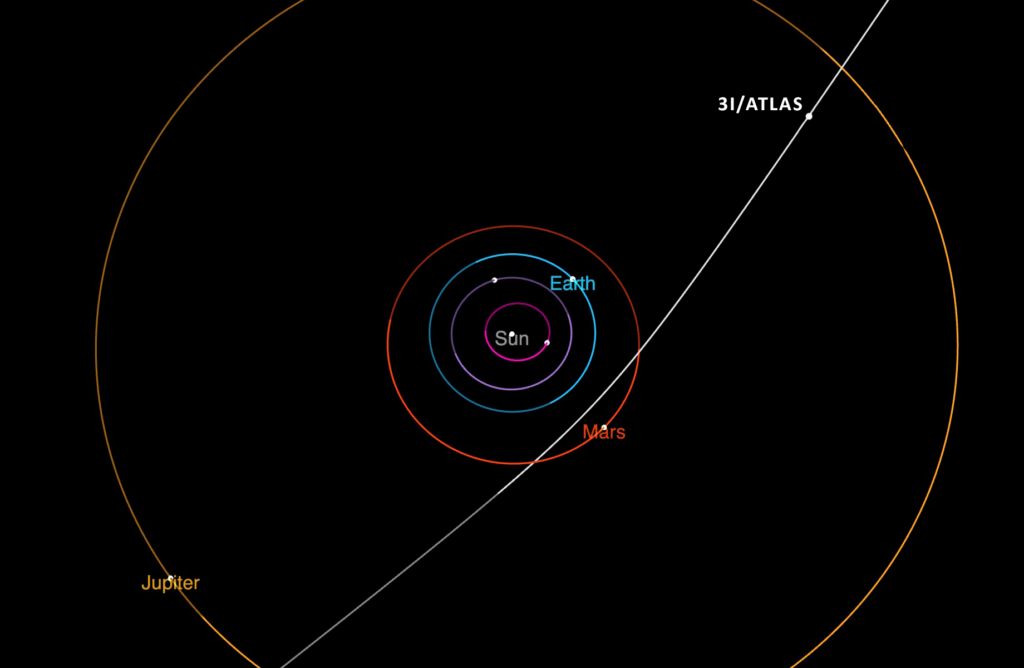
The ATLAS system (short for Asteroid Terrestrial-impact Last Alert System) is a NASA-funded observatory designed to detect near-Earth objects. On July 1, 2025, it spotted a faint object moving quickly — and in a path not consistent with objects orbiting the Sun.
Follow-up calculations confirmed the object’s hyperbolic orbit, which is the main signature of an interstellar origin.
Quick coordination between observatories across the world led to the confirmation: this was something brand new.
What Makes 3I/ATLAS Cosmic Visitor Discovery So Unusual?
1. It’s Changing Colors
As it travels closer to the Sun, 3I/ATLAS has shifted from bluish to reddish hues, a phenomenon rarely seen in solar comets.
This suggests the surface chemistry is changing rapidly — possibly revealing new compounds or minerals as sunlight heats it.
2. Heartbeat-Like Brightness
Astronomers have detected pulsing brightness patterns, repeating at regular intervals — something like a heartbeat. While this is likely caused by rotation or volatile jets, the rhythm and consistency are unusual.
This behavior hasn’t been observed to this degree in other comets, including ʻOumuamua or Borisov.
3. Rich in Volatile Compounds
Spectral analysis from NASA’s James Webb Space Telescope (JWST) and Hubble has detected:
- Carbon monoxide (CO)
- Methanol
- Formaldehyde
- Water ice
These are organic compounds, some of which are precursors to amino acids — the building blocks of life. This supports the idea that other solar systems could produce life-enabling materials, just like ours.
Captured in Stunning Detail
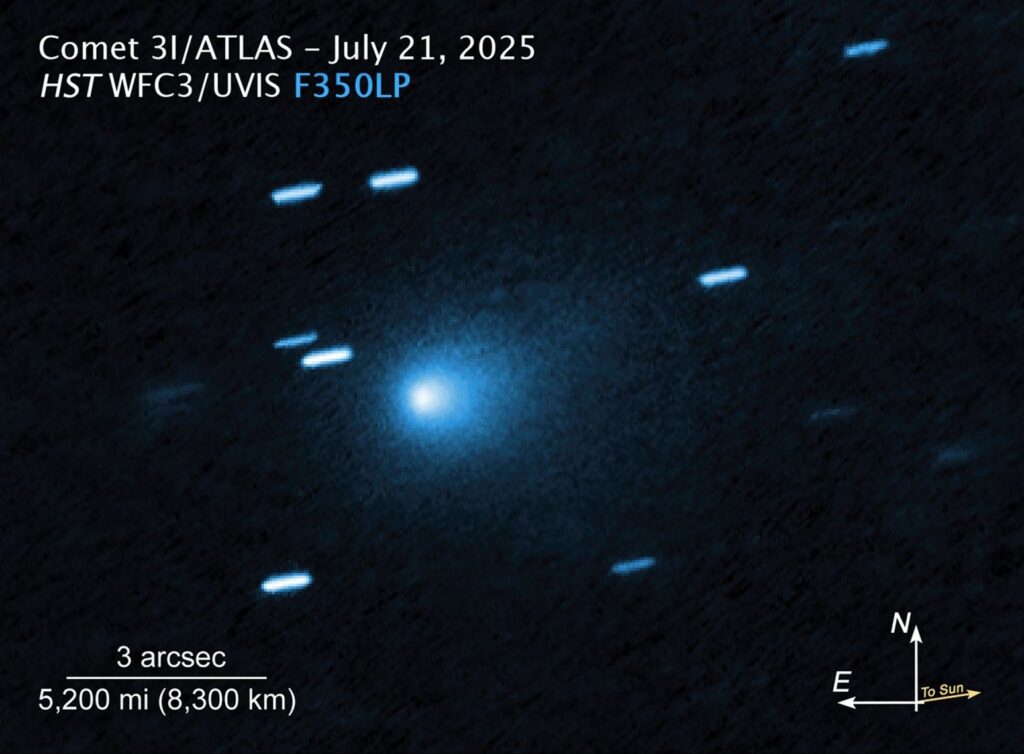
NASA’s Hubble Space Telescope and the European Space Agency’s JUICE mission both captured high-resolution images of 3I/ATLAS as it approached the inner solar system.
These images show:
- A coma (the glowing cloud around the comet) nearly 30,000 miles wide
- A tail structure made of fine dust particles
- Unusual streaks that suggest rapid outgassing
ESA’s JUICE probe, currently en route to Jupiter, was able to capture side-profile images of the comet — offering unique vantage points not visible from Earth.
What Does 3I/ATLAS Cosmic Visitor Discovery Mean for Science and Careers?
The discovery of 3I/ATLAS is a huge deal for space science, and it directly impacts:
- Planetary Scientists: They can study how materials form outside our solar system.
- Astrobiologists: The organic compounds could inform theories about life’s origin in the galaxy.
- Aerospace Engineers: Understanding interstellar object trajectories can inform future defense or mission planning.
- Educators: This event provides a rare opportunity to teach planetary formation, chemistry, and astronomy in real time.
Already, research papers are being drafted. Expect to see grant funding, student projects, and mission proposals around this comet for years to come.
How to See 3I/ATLAS?
You can’t see it with the naked eye, but if you’re an amateur astronomer, here’s what you’ll need:
Tools:
- At least a 6” reflector telescope
- Equatorial mount for tracking
- Observation apps like SkySafari or Stellarium
When to Look:
- Best visibility: Late December 2025 to early February 2026
- Look near constellations: Orion and Taurus
Even if you don’t own a telescope, many observatories offer online viewing parties or live telescope feeds.
Get Involved: Citizen Science Projects
NASA and ESA encourage public participation in space discoveries. Here’s how you can help:
- Submit your images or data to the Minor Planet Center.
- Join a Zooniverse project that tracks object behavior.
- Participate in open telescope nights and contribute observations.
Even kids can get involved — many student astronomy clubs are logging sightings and sharing their data with universities.
What We’ve Learned from Past Interstellar Visitors?
Let’s put 3I/ATLAS in context with its predecessors.
| Object | Year Discovered | Notable Traits |
|---|---|---|
| 1I/ʻOumuamua | 2017 | Cigar-shaped, no tail, possible artificial speculations |
| 2I/Borisov | 2019 | Acted like a typical comet, but with alien composition |
| 3I/ATLAS | 2025 | Bright, colorful, active, rich in complex molecules |
Each object has taught us something new. But 3I/ATLAS is the most active and chemically rich of the three, making it the most scientifically valuable yet.
Daylight Saving Time 2026 – Here’s When Your Clocks Fall Back This Year