
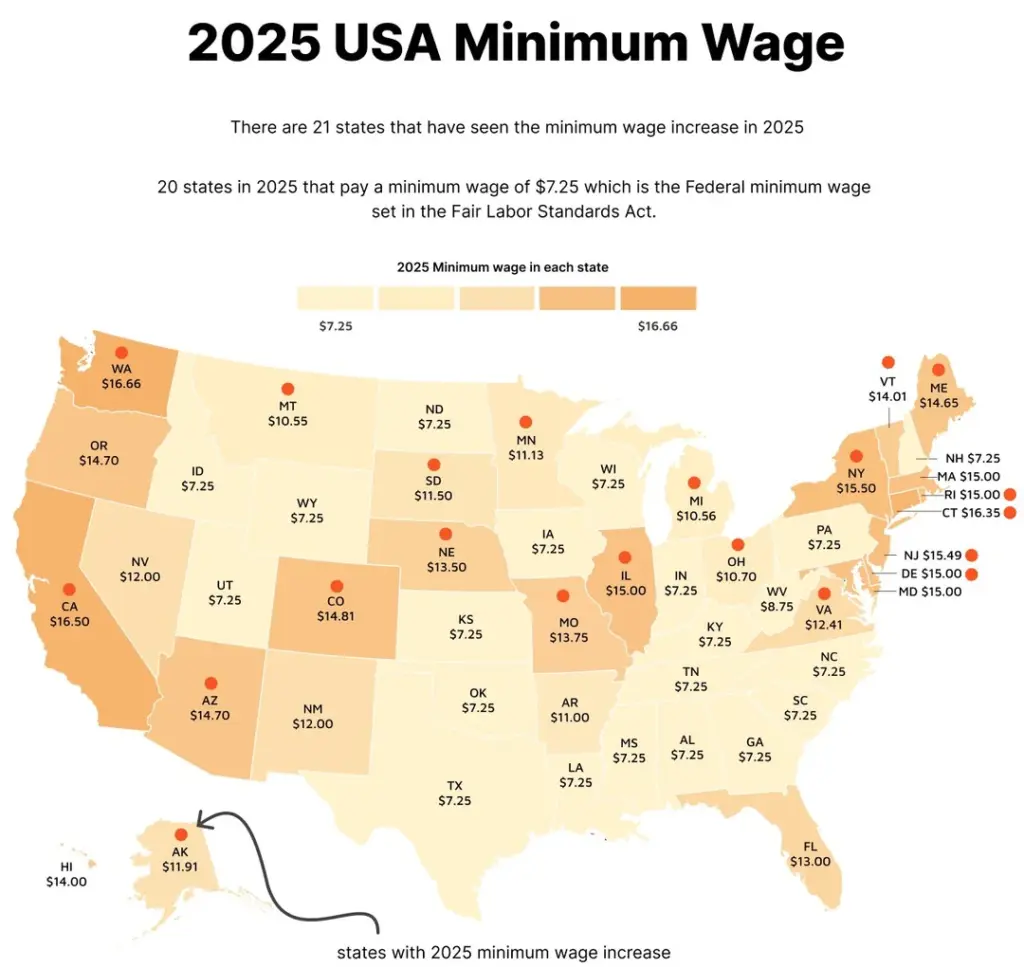
The minimum wage increase in the United States in 2026 will bring higher pay floors to more than 20 states, largely through laws that tie wages to inflation or phased statutory hikes. While the federal minimum wage will remain unchanged at $7.25 an hour, state-level increases will push hourly pay above $17 in some parts of the country, deepening regional differences in labor costs and living standards.
Table of Contents
Minimum wage increase in the United States in 2026
| Key Fact | Detail |
|---|---|
| Federal minimum wage | $7.25 per hour, unchanged since 2009 |
| States raising wages in 2026 | More than 20 states |
| Highest projected state rate | Washington, above $17 per hour |
With inflation still shaping household budgets, the minimum wage increase in the United States in 2026 underscores how states, not Washington, are driving wage policy. As automatic adjustments take effect, workers’ pay will increasingly depend on where they live rather than a national standard.
How the Minimum Wage Increase in the United States in 2026 Works
Unlike many industrialized countries, the United States sets its wage floor through a mix of federal, state, and local laws. Congress has not raised the federal minimum wage since 2009, leaving states to act independently.
According to the U.S. Department of Labor, more than half of U.S. states now set their own minimum wages above the federal level. Many of the 2026 increases are automatic, triggered by consumer price index formulas written into state law.
“These are not discretionary decisions made year to year,” said David Cooper, a senior economic analyst at the Economic Policy Institute. “They are the result of legislation passed years ago to prevent wages from eroding due to inflation.”
Inflation Indexing Explained
Inflation-indexed minimum wages adjust annually based on changes in consumer prices, typically using regional or national Consumer Price Index (CPI) measures. This mechanism aims to preserve purchasing power rather than deliver real wage growth.
States including Washington, California, Arizona, and Colorado use CPI-linked formulas. When inflation rises sharply, as it did between 2021 and 2023, these automatic increases become more pronounced.
Economists note that indexing reduces political uncertainty for workers and employers alike. “Indexation removes the need for repeated legislative battles,” said Arindrajit Dube, a labor economist at the University of Massachusetts Amherst. “But it also means wages rise even during economic slowdowns.”
States Expected to See the Highest Minimum Wages in 2026
Several states on the West Coast and in the Northeast will again top national rankings for minimum pay.
Washington State
Washington is projected to have the highest statewide minimum wage in the country in 2026, exceeding $17 per hour. The increase reflects annual inflation indexing administered by the Washington State Department of Labor & Industries.
State officials say the formula is designed to maintain purchasing power in a high-cost economy, particularly in the Seattle metropolitan area.
Washington’s minimum wage law also applies broadly, with limited exemptions, making it one of the most comprehensive in the country.
California and New York
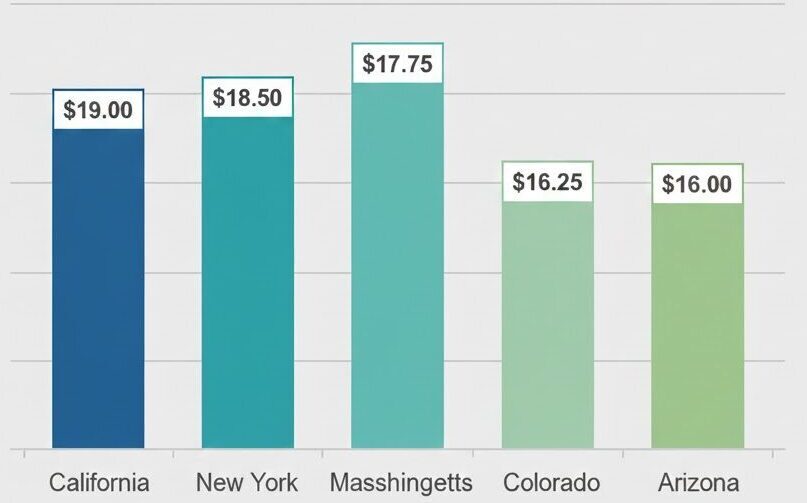
California’s minimum wage is also expected to rise again in 2026 under its inflation-linked statute, pushing the statewide rate toward the upper $16 range. Separate laws already require higher pay for fast-food and health care workers.
New York will maintain a tiered system. Workers in New York City, Long Island, and Westchester County will earn at least $17 per hour, while the rest of the state will remain lower, according to the New York State Department of Labor.
The tiered approach reflects cost-of-living differences but has drawn criticism from labor advocates who argue that upstate regions also face rising housing and food costs.
States with the Largest Year-Over-Year Increases
Some states will not lead in absolute wage levels but will record notable jumps compared with prior years.
Michigan is among them. Under a state law passed in 2018, the minimum wage is scheduled to rise sharply in 2026 as part of a delayed phase-in. The Michigan Department of Labor and Economic Opportunity estimates the increase will exceed a dollar per hour in a single step.
Missouri and Nebraska are also set to reach the $15 threshold in 2026, following voter-approved ballot initiatives that mandated gradual increases.
“These states illustrate how voter-driven wage policy can produce sizable changes, even in traditionally lower-wage regions,” said Louise Sheiner, a policy director at the Brookings Institution.
Ballot Initiatives and Public Opinion
In recent years, minimum wage increases have repeatedly passed through ballot measures, even in politically conservative states. Analysts say this reflects strong public support for higher wages amid rising living costs.
According to Pew Research Center, a majority of Americans support raising the minimum wage, although opinions differ on how high it should go and how quickly increases should occur.
Regional and Economic Implications
Economists note that the minimum wage increase in the United States in 2026 will reinforce existing regional divides. Coastal states with higher housing and living costs tend to set higher wage floors, while much of the South continues to rely on the federal minimum.
Business groups, including the National Federation of Independent Business, argue that higher wages increase labor costs for small employers. Labor advocates counter that wage growth improves worker retention and consumer spending.
Research from the Congressional Budget Office suggests that moderate minimum wage increases raise earnings for low-wage workers but may have mixed effects on employment, depending on local economic conditions.
Sector-Specific Effects
Industries with high concentrations of minimum wage workers—such as retail, food service, hospitality, and home health care—are expected to feel the strongest effects.
Some employers have responded to past increases by raising prices, reducing hours, or investing in automation. Others report improved morale and lower turnover, offsetting higher payroll costs.
Impact on Workers and Households
For workers earning near the minimum wage, even small hourly increases can translate into meaningful annual gains. A one-dollar increase amounts to roughly $2,000 per year for a full-time worker.
Advocacy groups argue that these increases help workers keep pace with rising rents, health care costs, and food prices. However, critics note that minimum wage workers are not evenly distributed across households and that some benefits flow to secondary earners.
The Bureau of Labor Statistics estimates that about 1.3 million workers earn at or below the federal minimum wage, though many more earn slightly above it and are indirectly affected by state increases.
Why the Federal Minimum Wage Remains Unchanged
Despite repeated proposals in Congress, there is no federal minimum wage increase scheduled for 2026. Efforts to raise the national floor have stalled amid partisan disagreement over inflation and business costs.
The White House has reiterated support for a higher federal minimum wage, but any change would require congressional approval.
As a result, state policies will continue to define pay standards for millions of workers.
International Comparison
Among advanced economies, the United States is unusual in lacking a national mechanism to regularly adjust its minimum wage. Countries such as the United Kingdom and Germany use independent commissions to review wage floors annually.
Some economists argue that a similar model could reduce political gridlock in the U.S., while others caution that regional cost differences make a single national rate difficult to implement.
FAQ
Q: Will the federal minimum wage increase in 2026?
No. The federal minimum wage is set to remain $7.25 per hour unless Congress passes new legislation.
Q: Which state will have the highest minimum wage in 2026?
Washington state is expected to lead with a rate above $17 per hour.
Q: Do cities have higher minimum wages than states?
Yes. Many large cities, including Seattle and New York City, set local minimum wages above state levels.
Q: Will tipped workers see the same increases?
That depends on state law. Some states require tipped workers to earn the full minimum wage, while others allow a lower cash wage supplemented by tips.